Precision Aluminum & Magnesium Die Casting for Automotive, EV and Aerospace
KingShip engineers end-to-end die casting manufacturing — from mold-flow simulation and 5000T large structural casting to tight-tolerance CNC finishing and real-time X-ray porosity inspection.
Who We Are
A vertically integrated B2B die casting manufacturer delivering reliability from molten metal to finished component.
KingShip (Dongguan) Precision Manufacturing Co., Ltd. is a dedicated B2B supplier of high-pressure aluminum and magnesium alloy die casting, in-house CNC post-processing, semi-solid rheocasting and professional tooling engineering. For more than two decades we have helped automotive, electric-vehicle, aerospace, medical and industrial customers turn demanding geometries into repeatable, high-integrity production parts.
We are not a trading company. Every casting is produced inside our own Dongguan facility, where modern cold-chamber die casting cells are integrated with fully automated robotic extraction, real-time X-ray porosity detection and a high-precision CNC machining center. This vertical integration lets us control dimensional accuracy, surface quality and lead time across the entire process — design, simulation, casting, machining, finishing and inspection — under a single quality management system certified to ISO 9001 and IATF 16949.
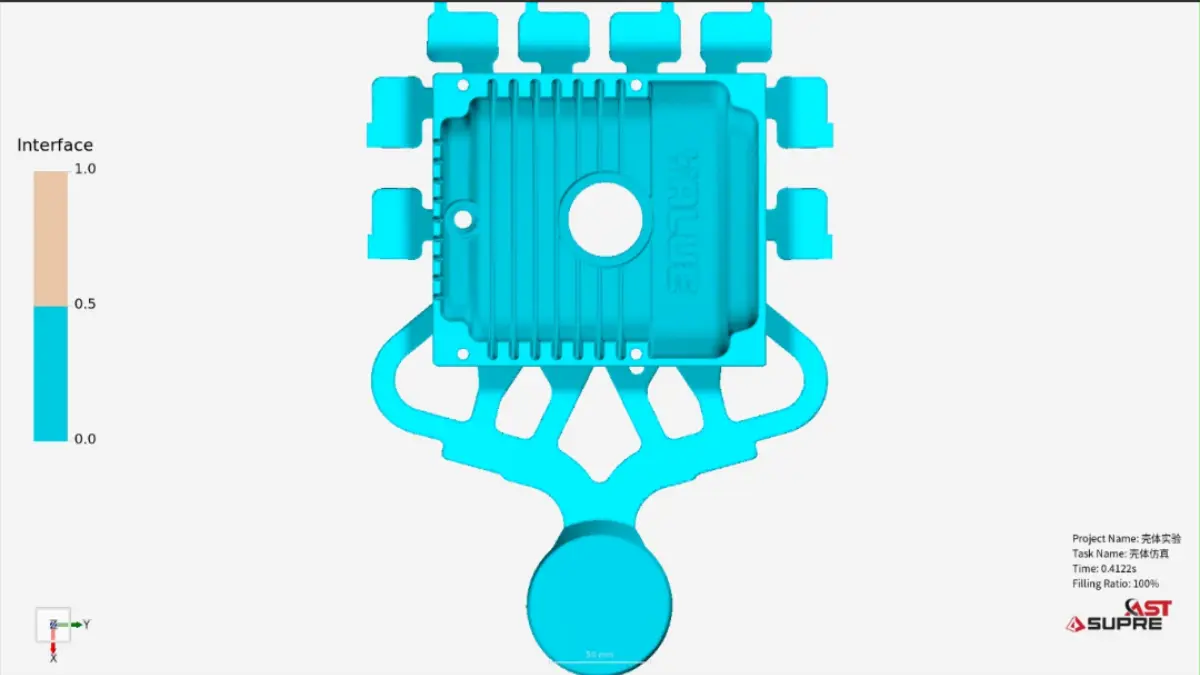
Our engineering team collaborates with customers from the first DFM review, using Magma and Moldflow simulation to eliminate cold shuts, air entrapment and shrinkage porosity before the first tool is cut. The result is a shorter development cycle, lower piece cost and structural components that pass qualification on the first try. Whether you need a lightweight magnesium bracket, a heat-treatable semi-solid rheocast part, or a 5000T large structural casting for an EV battery platform, KingShip is built to be your long-term manufacturing partner.
Manufacturing Capability Overview
Six integrated processes that take your program from prototype to high-volume production.
Aluminum Die Casting
High-pressure die casting in ADC12, A380 and A356 with tight-tolerance CNC finishing.
Learn more 2Magnesium Die Casting
Lightweight AZ91D and AM60B magnesium die casting for weight-critical components.
Learn more 3Semi-Solid Rheocasting
Low-porosity, heat-treatable rheocast components for structural applications.
Learn more 45000T Large Structural Casting
Extra-large thin-wall structural castings on our 5000-ton die casting machine.
View details 5Precision CNC Machining
3, 4 and 5-axis CNC machining and post-processing for cast components.
Learn more 6Die Casting Tooling
In-house tool design, manufacturing and maintenance for long mold life.
Learn moreOur Manufacturing Process
From design validation to finished, inspected components — a vertically integrated flow under one quality system.
Magma & Moldflow flow & solidification analysis
400T–5000T cold-chamber high-pressure cells
3 / 4 / 5-axis finishing to ±0.01 mm
Real-time X-Ray porosity & CMM
Anodizing, powder coating & impregnation
Aluminum Die Casting
Aluminum high-pressure die casting is the backbone of our production. We cast a wide range of structural and functional components in ADC12, A380, A356 and A360 alloys, balancing thermal conductivity, corrosion resistance and dimensional stability for demanding service environments. Our cold-chamber machines span 400T to 5000T, allowing us to serve everything from intricate thin-wall enclosures to large automotive structural parts in a single shot.
Every aluminum die casting program begins with mold-flow simulation. By modeling filling, solidification and cooling before tooling is built, we remove cold shuts, misruns and shrinkage porosity at the design stage rather than on the production line. Post-casting, in-house CNC machining centers hold critical mating surfaces to ±0.01 mm, and secondary operations such as anodizing, powder coating, shot blasting and impregnation are coordinated within the same facility.
Typical applications include automotive powertrain housings, EV battery trays and brackets, heat sinks, lighting housings and electronic enclosures. For customers who need verified material behavior, we publish engineering references on ADC12 properties and A356 structural integrity so design teams can specify with confidence.
Magnesium Die Casting
Magnesium die casting delivers the ultimate weight reduction — roughly one-third lighter than aluminum at comparable stiffness — making it the material of choice for weight-critical automotive, aerospace and premium electronics components. KingShip casts AZ91D and AM60B magnesium alloys on dedicated hot- and cold-chamber machines, with minimum wall thickness down to 1.0 mm for thin-wall, complex geometries.
Magnesium’s high strength-to-weight ratio and excellent EMI/RFI shielding are valuable for electric-vehicle brackets, sensor housings, drone frames and handheld devices. We protect surface integrity with passivation and electroplating processes tuned for magnesium corrosion resistance, and we verify wall thickness and internal quality with real-time X-ray inspection before shipment.
Because magnesium casting demands strict process control, our engineers manage melt protection, injection velocity and die temperature closely to avoid oxidation and hot cracking. The outcome is a lightweight, dimensionally stable component that helps OEMs hit aggressive vehicle-mass and range targets without sacrificing structural performance.
Semi-Solid Rheocasting
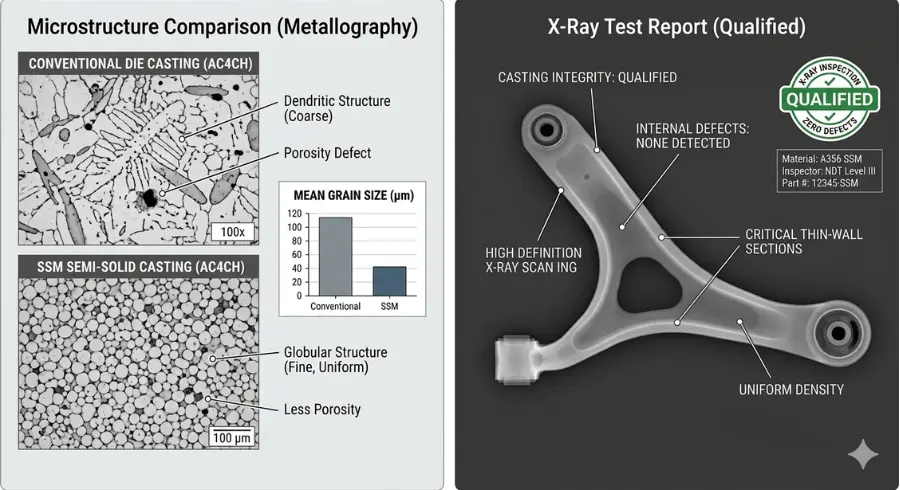
Semi-solid rheocasting is our solution for parts that must combine low porosity, high ductility and heat-treatability. By forming the alloy in its semi-solid state — a slurry of solid globules suspended in liquid — rheocasting almost eliminates gas entrapment and shrinkage porosity that conventional high-pressure die casting cannot fully avoid.
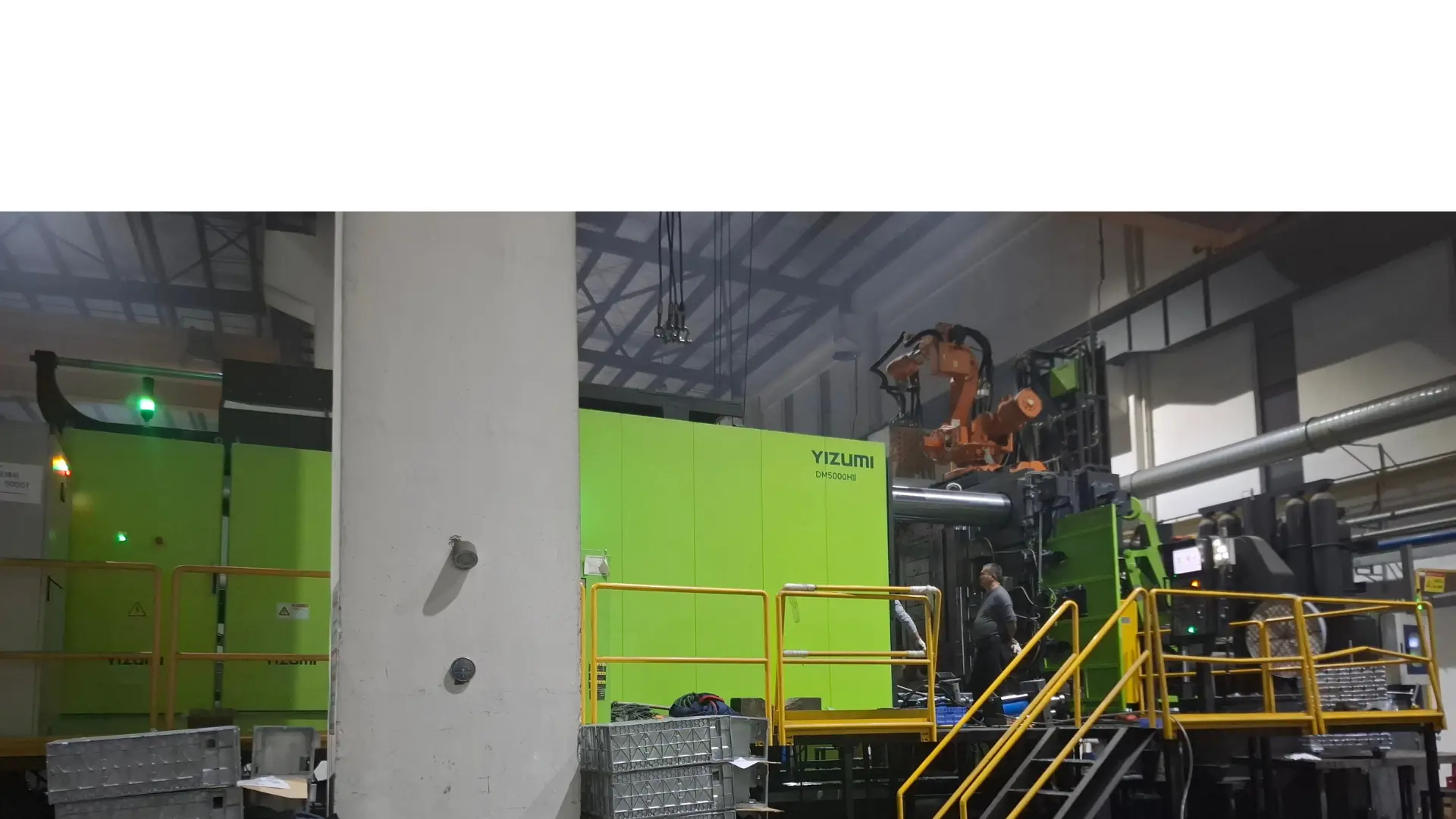
The result is a casting that can be T5 or T6 heat treated, welded and mechanically worked, opening the door to structural safety components where flaw-free integrity is non-negotiable. KingShip operates a Yizumi semi-solid rheocasting system and validates microstructural uniformity with metallography and real-time X-ray comparison, so customers can qualify rheocast parts for crash-relevant and load-bearing applications.
Rheocasting is especially attractive for EV and aerospace structural nodes, suspension brackets and booms where fatigue life matters. By reducing porosity at the source, we shrink the inspection burden downstream and improve the predictability of every shipped lot.
5000T Large Structural Casting
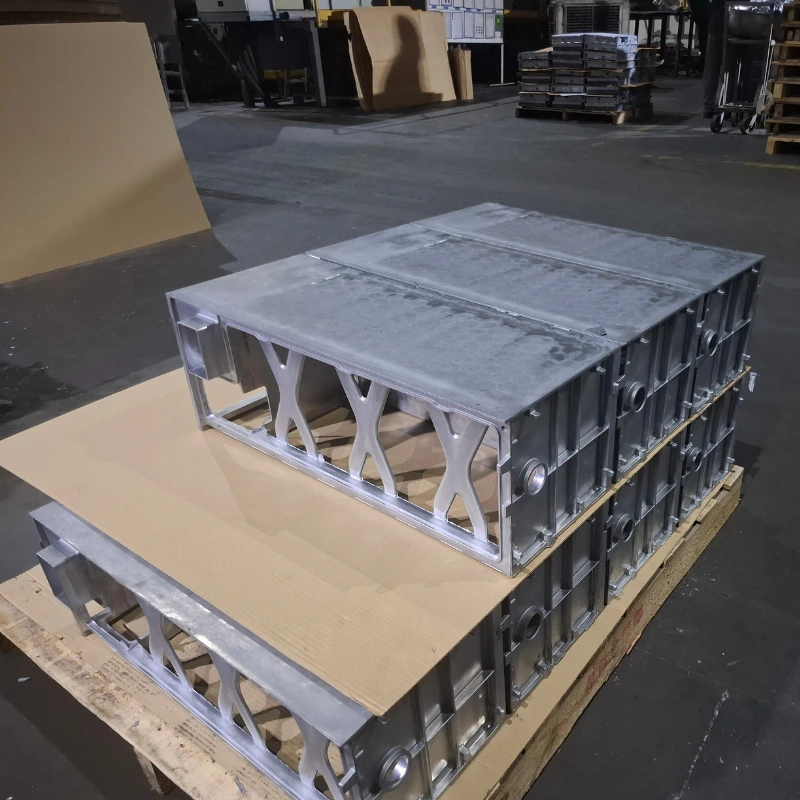
Our 5000-ton cold-chamber die casting machine is built for the largest, thinnest-wall structural components in the automotive and EV industries. Large structural castings — such as battery tray side rails, shock towers, tunnel housings and crossmembers — consolidate what used to be dozens of stamped and welded stampings into a single, stiff, lightweight aluminum part.
Producing these parts demands more than tonnage. It requires precise shot control, thermal management of a very large die, and disciplined process windows to keep warpage and porosity in check across a meter-scale footprint. KingShip’s engineering team models the entire casting system, then validates first articles with CMM, X-ray and leak testing before ramp.
By integrating large structural casting with in-house CNC machining and finishing, we deliver a dimensionally complete assembly-ready component, not just a raw casting. This reduces customer inbound logistics, welding distortion risk and total program cost while improving vehicle stiffness and crash performance.
Precision CNC Machining
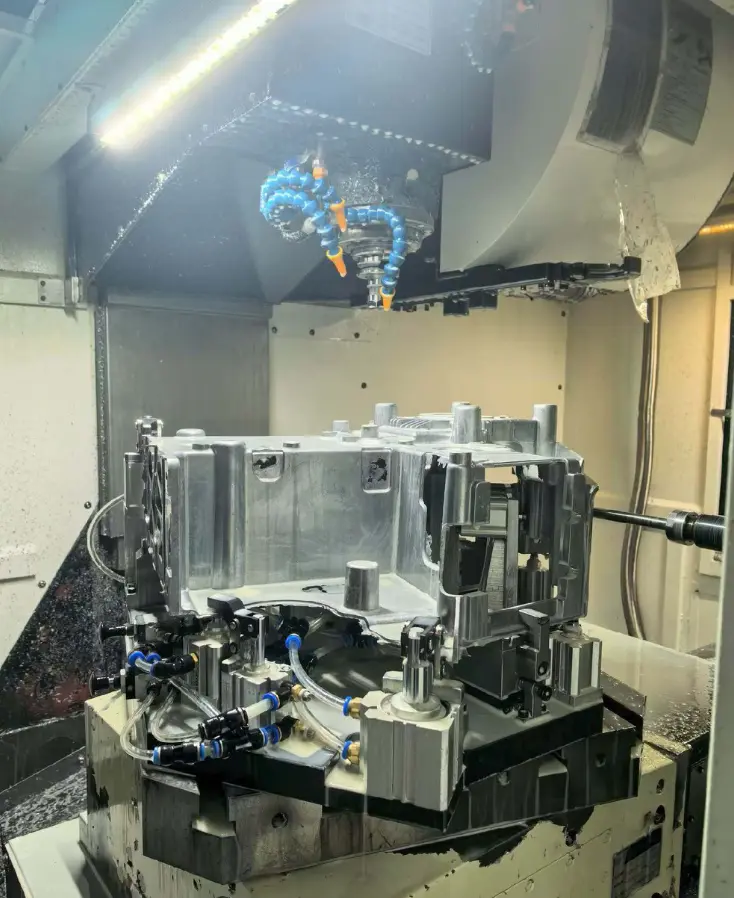
Casting is only half the story. KingShip’s in-house high-precision CNC workshop completes the component — drilling, threading, milling and boring the critical mating surfaces that the die casting process cannot reach. Our 3-axis, 4-axis and high-speed 5-axis machining centers hold tolerances up to ±0.01 mm on aluminum and magnesium parts.
Because machining sits next to casting, we eliminate the hand-off delays and quality disputes that come with outsourcing. Datums are consistent from cast to cut, first-article reports are generated on the same floor, and last-minute design tweaks flow straight back to the cell. We also perform value-added operations such as helical threading, boss facing and tight-tolerance bores for sealing surfaces.
For pressure-sealed components we add automated leak testing immediately after machining, so airtightness is confirmed before the part leaves the building. The net effect is a finished, inspection-ready component delivered from a single supplier.
Die Casting Tooling
Tooling quality defines everything that follows. KingShip operates an in-house tooling shop using advanced CAD/CAM, Pro/E, UG and Moldflow simulation to design and build dies that run longer and produce cleaner parts. Optimized gating and cooling systems reduce cycle time, minimize porosity and extend mold life beyond 100,000 shots.
Keeping tooling under our own roof means faster iteration: engineering changes, maintenance and refurbishment happen without third-party lead times. It also lets us protect proprietary gating know-how and keep it consistent across a product family. For low-volume bridge programs we offer bridge tooling that gets prototypes into your hands quickly before committing to a full production die.
A well-engineered die is the cheapest insurance against scrap, downtime and field failures. That is why KingShip treats tooling as a core competency, not a purchased commodity.
Quality Control & Certification
A zero-defect mindset backed by international certification and non-destructive testing.
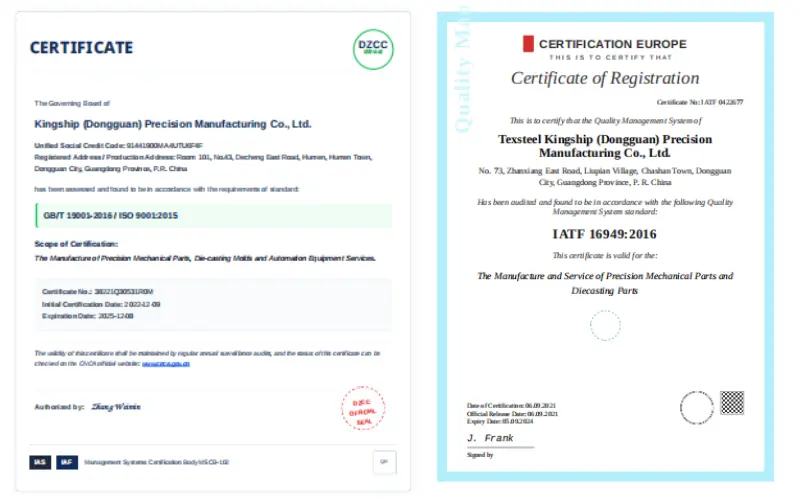
KingShip operates a comprehensive Quality Management System built for automotive, aerospace and medical-grade expectations. Our facility is certified to IATF 16949 and ISO 9001, and every high-pressure die casting operation is governed by documented process control, statistical monitoring and continuous improvement.
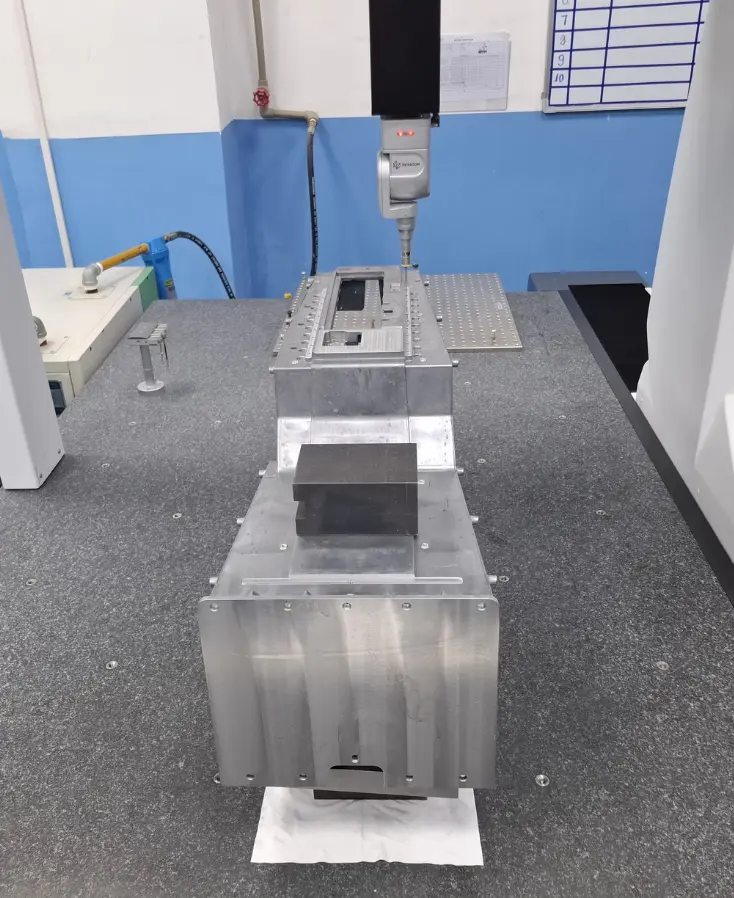
Structural integrity is verified, not assumed. Real-time X-ray detector systems perform non-destructive testing to reveal internal porosity, cracks and inclusions that surface inspection would miss. Coordinate Measuring Machines (CMM) confirm dimensional accuracy against the CAD model, while automated leak testing validates airtightness and fluid-handling performance for pressure-sealed components. Finishing steps such as SureTech 650 surface treatment complete the downstream process.
This layered inspection strategy means customers receive parts that are qualified before shipment, not discovered defective on the assembly line — protecting your line, your schedule and your brand.
- ✓Real-time X-Ray Inspection
- ✓CMM Dimensional Verification
- ✓Automated Leak Testing
- ✓SureTech 650 Surface Treatment
Production Equipment
Modern, integrated machinery that keeps quality and throughput under one roof.
5000T Die Casting Machine
Extra-large cold-chamber high-pressure die casting for meter-scale structural components.
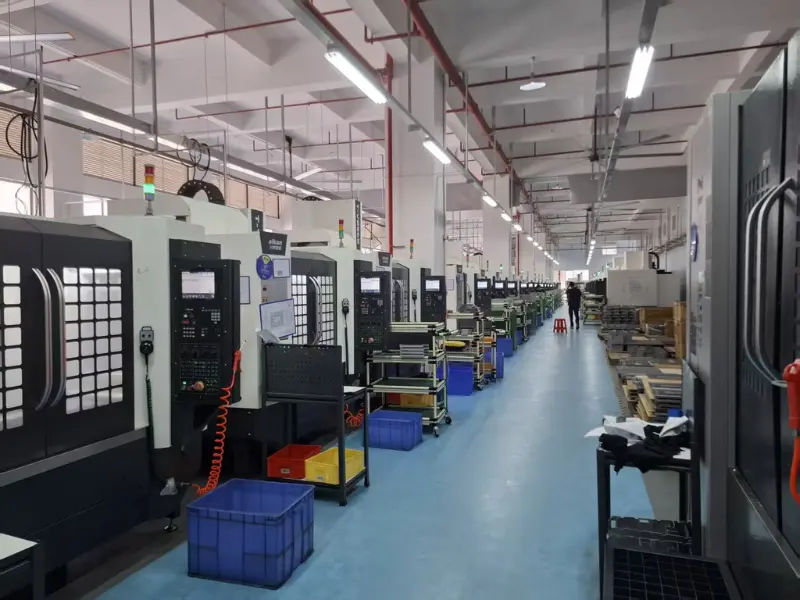
Precision CNC Machining Centers
High-speed 3, 4 and 5-axis machining for tight-tolerance post-processing.
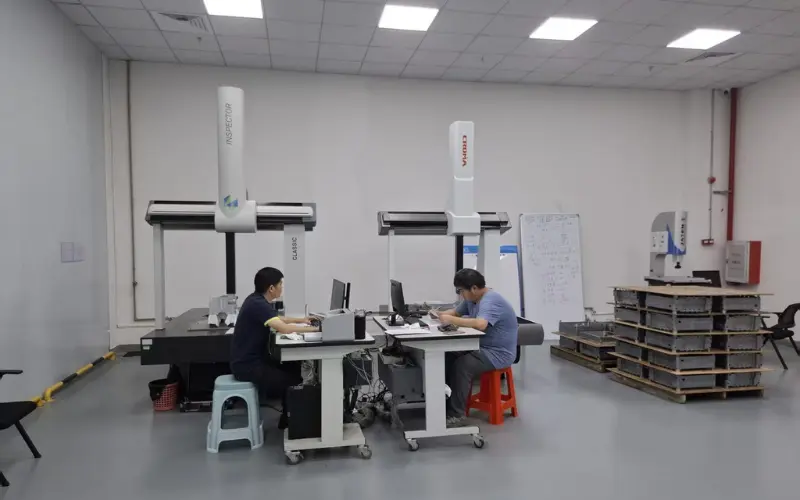
CMM Inspection Equipment
Coordinate measuring machines verify dimensional accuracy against CAD models.
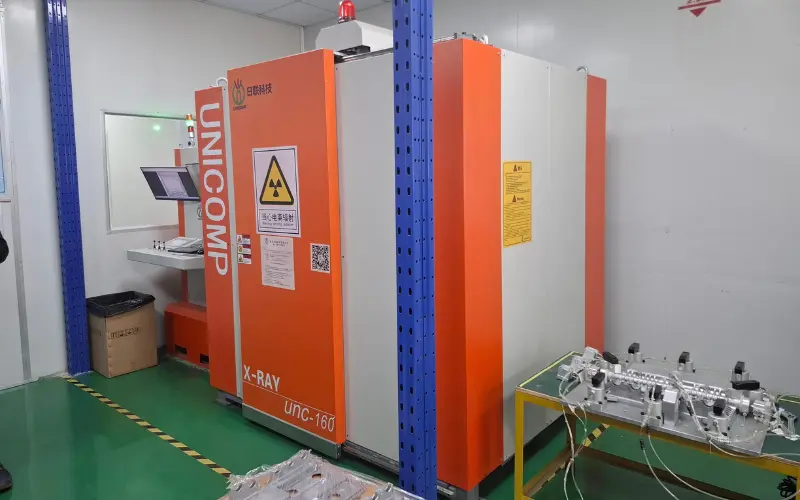
X-Ray Porosity Detection
Real-time X-ray systems perform non-destructive internal porosity inspection.
Industries We Serve
Material and process expertise tuned to the demands of each sector.
Automotive
Powertrain, structural and thermal-management components with IATF 16949 discipline.
EV
Battery structures, housings and brackets for lightweight, long-range platforms.
Industrial
Durable enclosures, frames and mechanism parts for demanding environments.
Medical
Clean, dimensionally stable components for diagnostic and device applications.
Aerospace
Lightweight, high-integrity magnesium and aluminum parts for flight applications.
Technical Resources
Deep-dive engineering guides on alloys, porosity control and die casting design.
Frequently Asked Questions
What aluminum and magnesium alloys do you cast? +
What is your maximum die casting machine tonnage? +
Do you provide in-house CNC machining and inspection? +
Are you certified to automotive quality standards? +
Can you help with design for manufacturability (DFM)? +
What is the typical quotation lead time? +
Do you support low-volume bridge tooling? +
Request a Quote
Send your drawings and requirements — get an engineering review and formal quotation within 24 hours.