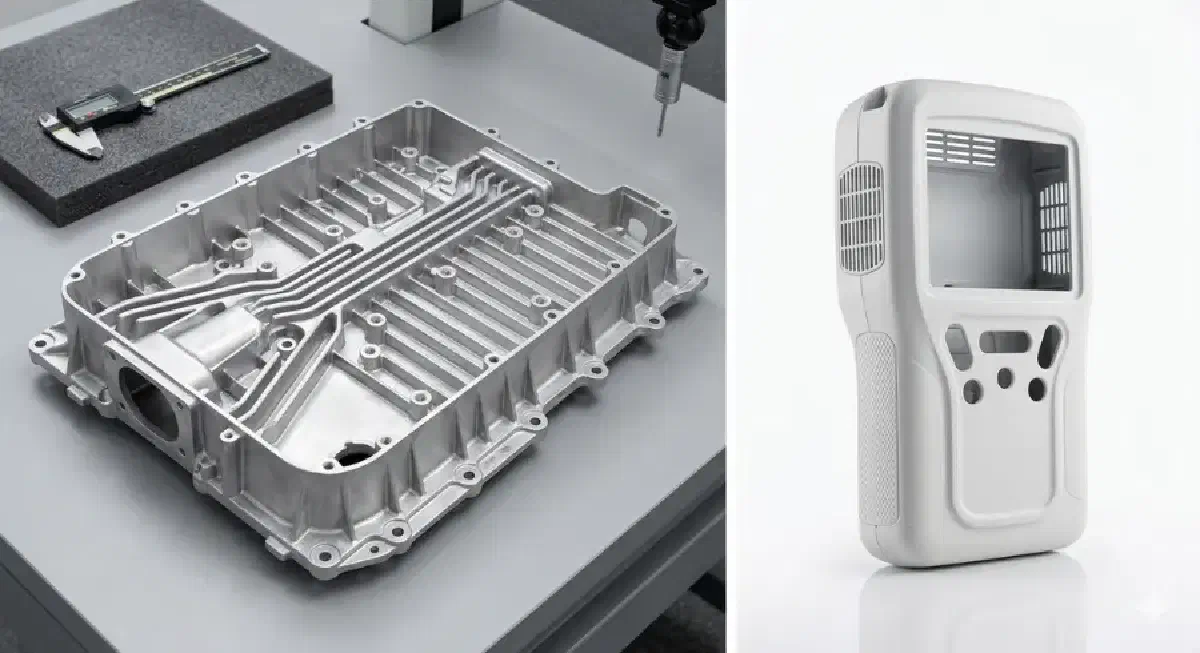
Semi-Solid Rheocasting for Lightweight Structural Components#
Semi-solid rheocasting (SSR) fills the gap between conventional high-pressure die casting (HPDC) and forging. It delivers near-net-shape, low-porosity-targeted structural components for automotive, EV and aerospace programs. Kingship runs SSR, thixocasting and vacuum-assisted rheocast on a 400T–3000T casting fleet with robotic pouring lines, processing A357 aluminum as the primary semi-solid grade and offering AZ91D / AM60B magnesium as a separate capability.
This page explains what semi-solid rheocasting is, how the process works, how it compares with HPDC and thixocasting, which alloys and designs are suitable, how we control quality, and exactly what to send when you request a quotation.
What Semi-Solid Rheocasting Is#
Conventional HPDC injects fully liquid metal at high velocity (often > 30 m/s), which entrains air and produces turbulent fill. Semi-solid rheocasting instead casts the metal in its liquid–solid “mushy” zone — typically 30–65% solid fraction — where the remaining solid exists as a globular, non-dendritic structure suspended in liquid.
Three physical effects make this valuable for structural parts:
- Laminar, low-turbulence fill. The thixotropic slurry is viscous at rest but flows under shear. It fills the cavity laminarly rather than turbulently, so it entrains far less air than HPDC.
- Lower solidification shrinkage. The pour temperature is roughly 100 °C below the fully liquid HPDC temperature, so there is less volume to feed as the part solidifies.
- Globular feeding. The spherical solid grains feed and pack better than dendritic arms, reducing shrinkage porosity and hot tearing.
The result is a part with porosity reduced versus HPDC and mechanical properties closer to forging than to conventional die casting — while keeping the high throughput and near-net-shape economics of casting.
How the Rheocasting Process Works#
SSR is a one-step, slurry-on-demand route. The steps below are illustrated in the schematic process flow.
Schematic process flow — illustrative, not a specific production cell.
- Melt & alloy. A357 (or project-specific grade) is melted, degassed and grain-refined to a controlled chemistry.
- Slurry preparation. The melt is cooled into the two-phase region and sheared (mechanical or electromagnetic stirring) into a globular semi-solid slurry at the target solid fraction.
- Dosing & injection. A controlled shot of slurry is injected into the die. Because the slurry is thixotropic, fill is laminar and air entrainment is minimal.
- Solidification & ejection. The part solidifies rapidly in the die and is ejected near-net-shape. Vacuum assistance can further reduce gas porosity where specified.
- Finishing. Trimming, shot blasting, CNC machining and surface treatment (e.g., anodizing) follow as required.
Semi-Solid Rheocasting vs HPDC vs Thixocasting vs Forging#
Choosing a process is a trade-off between porosity, strength, tolerances, cost and lead time. The table below is a general engineering guide; the right choice for a given part is confirmed in DFM.
| Attribute | Semi-Solid Rheocasting | High-Pressure Die Casting (HPDC) | Thixocasting | Forging |
|---|---|---|---|---|
| Feedstock | Liquid melt (on-demand slurry) | Liquid melt | Pre-cast non-dendritic billet | Solid billet / slug |
| Solid fraction at fill | 30–65% (mushy zone) | ~0% (fully liquid) | 30–65% (mushy zone) | 100% (solid) |
| Fill behaviour | Laminar, low air entrainment | Turbulent, high air entrainment | Laminar, low air entrainment | Solid deformation |
| Porosity tendency | Lower than HPDC | Higher (gas + shrinkage) | Lower than HPDC | Very low |
| Mechanical properties | Closer to forging than HPDC | Lower (porosity-limited) | Closer to forging than HPDC | Highest |
| Typical min. wall | 1.0–1.2 mm (project-dependent) | ~0.8–1.0 mm | 1.0–1.2 mm | N/A (formed) |
| Throughput / cost | Casting-level | Casting-level (lowest) | Casting-level | Slowest / highest |
| Best fit | Structural, leak-tight, lightweight | High-volume thin walls | Structural, consistent billet | Highest-load, simplest shapes |
Materials: A357 Aluminum and Related Grades#
A357 is Kingship’s primary semi-solid aluminum grade. It is an Al–Si–Mg alloy with higher magnesium than A356, giving higher strength and good response to T5/T6 heat treatment — suited to structural and aerospace-grade components.
| Grade | Family | Notes for semi-solid use |
|---|---|---|
| A357 | Al–Si–Mg (higher Mg) | Primary grade. Higher strength than A356; preferred for structural / high-reliability parts. Heat-treatable (T5/T6). |
| A356 | Al–Si–Mg (lower Mg) | Related workhorse grade; evaluated per project where A357’s extra strength is not required. |
| 319 | Al–Si–Cu | A distinct copper-containing grade used for powertrain / elevated-temperature parts. It is not the same as A357 and must not be confused with it; quoted only where the application needs its properties. |
| A360 / 360.0 | Al–Si (high Fe) | A standard conventional die-cast grade. Not a current semi-solid grade offered here. Listed only to avoid confusion with A357. |
Magnesium is a separate capability. AZ91D and AM60B magnesium are offered under the same semi-solid / magnesium rheocasting family, but they are not listed as materials of this aluminum process. If your program is magnesium-based, see our magnesium die casting services — material certificates accompany every inquiry.
Solid Fraction and the Process Window#
Semi-solid rheocasting is run at a solid fraction of roughly 30–65%, but this is a process window, not a fixed guarantee for every part. The achievable solid fraction depends on:
- the alloy’s liquidus–solidus range and sensitivity to shear,
- the part geometry and flow length,
- the gating / feeding concept and shot profile,
- the die temperature and cooling control.
We tune the process window per project during the DFM and process-development phase. The solid fraction is one of several levers (along with vacuum assistance, gating and heat treatment) used to hit the porosity and mechanical targets for a specific component.
Design Feasibility and Guidelines#
The table below summarises typical design guidance. Every value is project-dependent and confirmed during DFM — it is a starting point for engineering discussion, not a specification.
| Design parameter | Typical guidance | Notes |
|---|---|---|
| Minimum wall thickness | 1.0–1.2 mm | Depends on flow length, wall geometry and material. |
| Draft angle | 1–3° (per side) | Reduces stick and improves ejection. |
| Radii / fillets | ≥ 0.5 mm | Avoid sharp corners to limit stress and porosity. |
| Rib-to-wall ratio | ≤ ~0.6–0.8 | Controls feeding and warpage. |
| Bosses / stand-offs | Supported where possible | Minimize blind features that trap slurry. |
| Casting tolerance | CT5–CT7 (ISO 8062, indicative) | Wider than machining; design datums accordingly. |
| CNC tolerance (post-machining) | ±0.01 mm achievable | Applies to machined features, confirmed per geometry. |
| Wall thickness variation | Gradual transitions | Avoid sudden thick–thin steps that cause shrinkage. |
Quality Control and Inspection#
Quality is scoped to each program. Typical, project-scoped methods include:
- X-ray porosity inspection — qualitative/quantitative porosity assessment against the part’s acceptance criteria.
- CMM dimensional verification — first-article and in-process dimensional checks.
- Material certification — alloy composition and heat-treat records per inquiry.
- PPAP / release documentation — provided where the customer program requires it.
Kingship’s quality-system alignment (e.g., with IATF 16949 / ISO 9001 expectations) is confirmed during project qualification; specific certification status for a program is established at that stage. We do not claim a blanket zero-porosity or defect-free result — porosity is reduced versus HPDC and verified per part.
Applications#
Low porosity and lightweighting make SSR attractive wherever structural performance and weight matter:
- EV battery housings and trays — leak-tight, lightweight enclosures.
- Structural brackets and subframes — chassis and suspension members.
- Powertrain components — housings and carriers where 319 (copper-containing) may be specified.
- Aerospace brackets and housings — where A357’s strength and heat treatment help.
- Telecom / 5G enclosures and heat sinks — stiff, lightweight aluminum parts.
Secondary Operations#
A rheocast part is usually finished in-house to reduce handling and lead time:
- CNC machining — achievable post-machining tolerance to ±0.01 mm, confirmed per geometry and project.
- Shot blasting — surface preparation and cosmetic finish.
- Anodizing — corrosion resistance and appearance.
- Impregnation / sealing — where leak-tightness is specified.
- Assembly — sub-assembly and hardware insertion on request.
Request a Rheocasting Quotation#
A complete inquiry lets our engineers return useful DFM feedback quickly. Use the checklist below.
| What to provide | Why it matters |
|---|---|
| 3D model / drawing (STEP, IGES, PDF) | Enables DFM, gating and feasibility review. |
| Target alloy (e.g., A357) | Drives process route, slurry and heat treatment. |
| Estimated annual volume (EAU) | Determines tooling and process economics. |
| Critical dimensions & tolerances | Identifies which features need CNC vs as-cast. |
| Surface treatment (anodizing, blasting) | Confirms secondary-op capability. |
| Quality documentation (PPAP, certs) | Scopes inspection and release plan. |
| Target market / application | Informs material and regulatory requirements. |
Contact our engineers with the above, and we will return DFM feedback and a quotation.
Related Capabilities and Next Steps#
- Compare processes on our aluminum die casting and magnesium die casting pages.
- For tight-tolerance features, see CNC machining and tooling.
- Ready to discuss a part? Contact our engineers for DFM feedback and a rheocasting quotation.